

Student loan borrowers have navigated a series of federal repayment policy changes in recent years, from the pandemic-era payment pause to the introduction and subsequent elimination of the SAVE payment plan. As SAVE draws to a close, Numerator estimates that the shift could put $9.7 billion in annual consumer spending power at risk, with affected borrowers navigating higher monthly payments. For brands and retailers, it’s increasingly important to understand who these shoppers are, how they plan to adjust, and where spending may move.
How will the end of the SAVE payment plan impact consumer spending?
Numerator estimates that the end of the SAVE payment plan could reduce consumer spending power by $9.7 billion annually, as many borrowers face higher monthly payments under new repayment plans. In a Numerator Verified Voices survey of 2,000 consumers with current student loans, about 42% of borrowers previously enrolled in the SAVE program said they have already moved to a new plan, while 58% have yet to switch.
Among those who have switched from the SAVE plan, 57% say their monthly payments increased, 34% stayed about the same, and 9% decreased. The average monthly increase was $212 per month, while the average decrease was $166. Applied across the 7.5 million SAVE program participants as of early 2026, these changes translate to over $800 million in decreased spending power each month.
How will shoppers cover increased student loan payments?
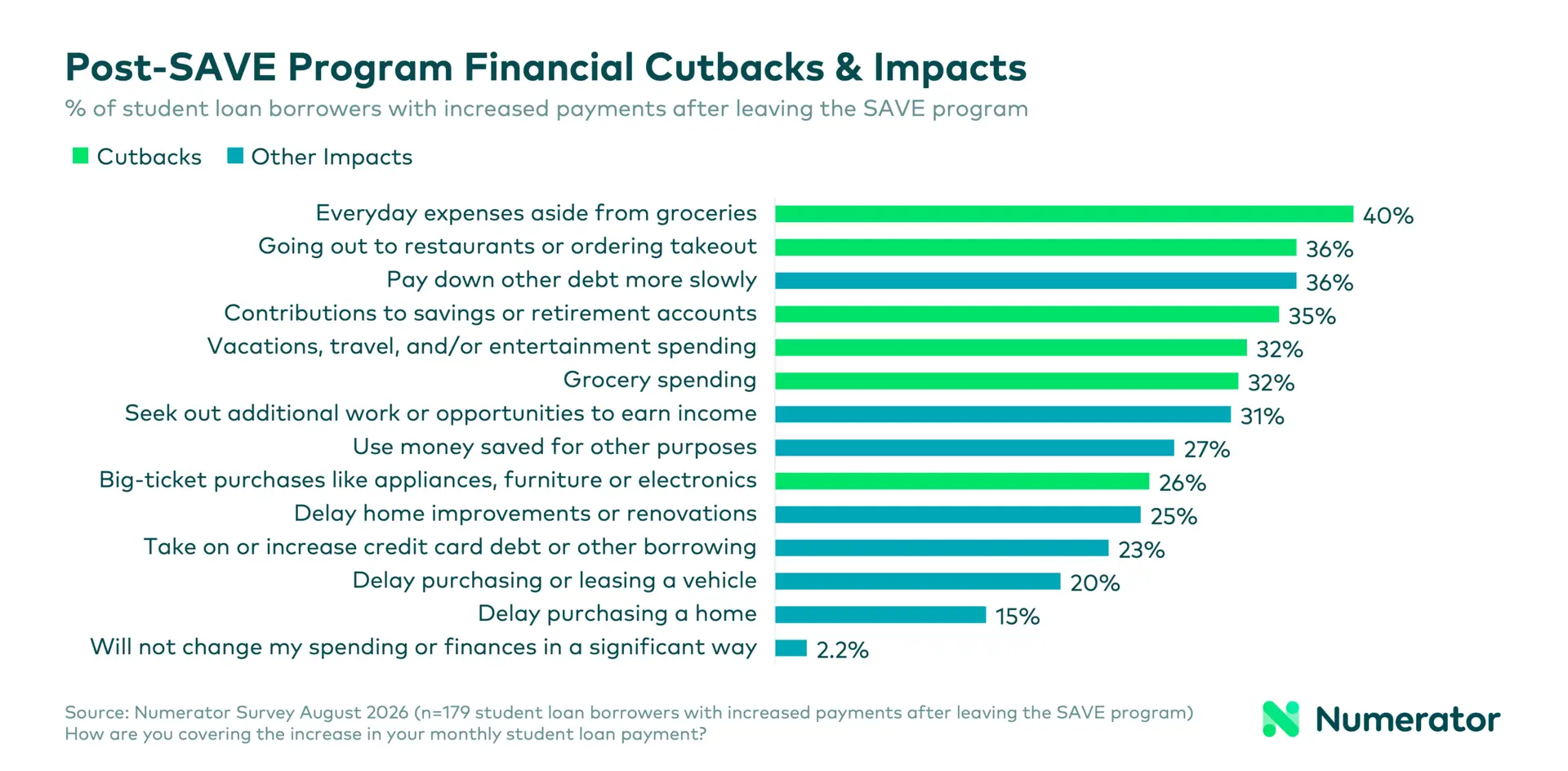
Borrowers facing higher monthly payments after leaving SAVE say they’ve covered the increases by cutting back on everyday expenses (40%), reducing restaurant visits and takeout (36%), and paying down other debt more slowly (36%). Borrowers outside of the SAVE program say that if their monthly payments increase in the future, they’re most likely to cut back on restaurants and takeout (47%), travel and entertainment (47%), or big-ticket purchases like appliances, furniture, or electronics (40%).
Consumers tend to follow predictable patterns when faced with tighter budgets. Our consumer sentiment tracker consistently shows that shoppers looking to save money seek out items on sale, cook more at home, and leverage coupons and discount codes.
If future student loan policy changes lead to widespread payment increases, we’ll likely see a decline in discretionary spending, and a number of impacted shoppers seeking out savings on their everyday necessities. This could mean looking for discounts on their preferred brands and products, switching to lower-priced items, or switching to retailers with better perceived savings. Brands can consider targeted promotions on everyday items to help meet shoppers’ needs during periods of financial pressure.
Which brands or retailers are most at risk from student loan cutbacks?
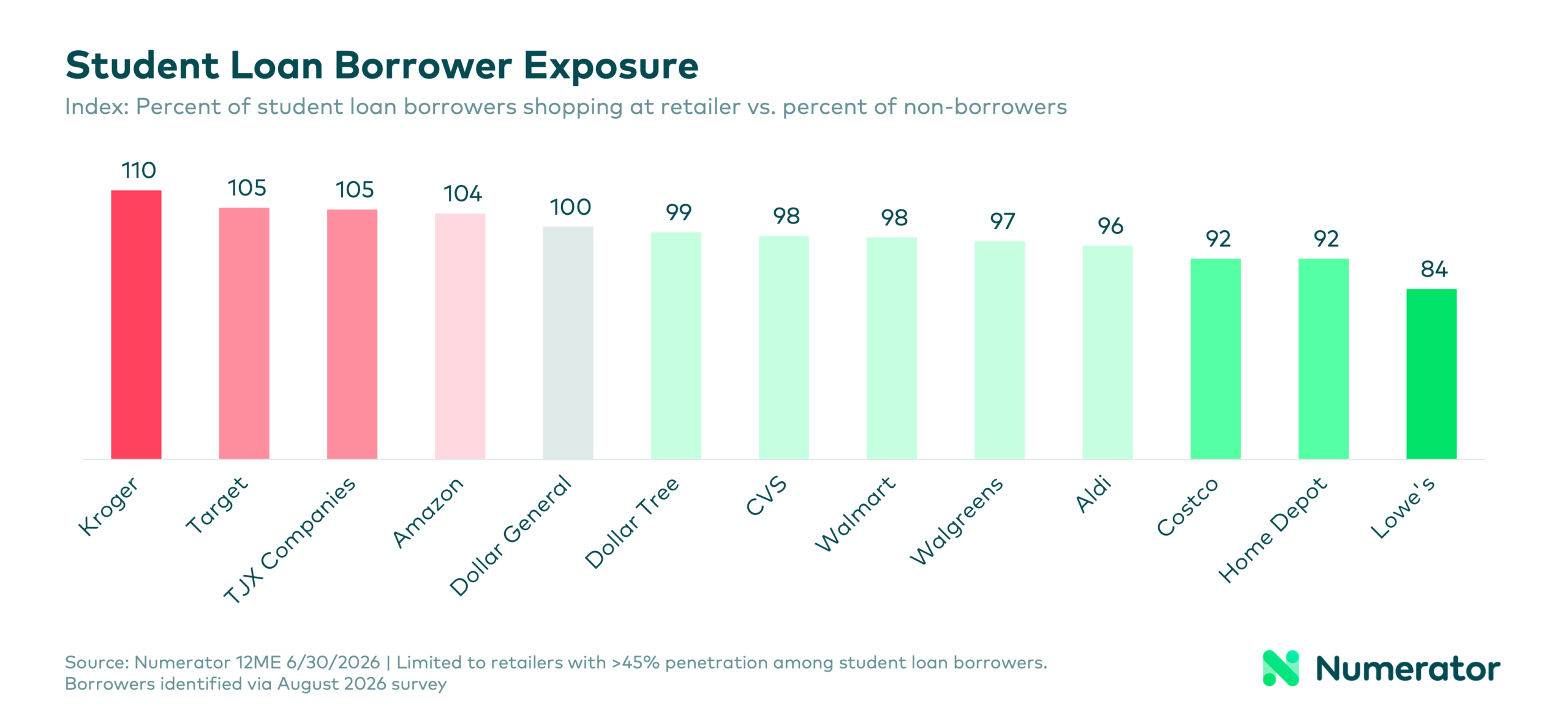
Brands and retailers whose shopper bases skew toward 21–44-year-olds with higher levels of education may be more exposed to changes in student loan payments. For example, Target is more popular with both higher-educated shoppers and those ages 21–44 than Walmart, suggesting it may face greater risk of spending pullbacks among affected borrowers.
Among major retailers beyond Target, Kroger and TJX stores face the highest exposure to student loan borrowers, while Home Depot and Lowe’s face the lowest. However, this exposure also creates an opportunity to use targeted, value-focused promotions and loyalty offers to help maintain engagement as household budgets tighten.
Quick-service restaurants (QSRs) see 10% higher spend among student loan borrowers than among non-borrowers. McDonald’s, Chick-fil-A, Taco Bell, and Starbucks, in particular, see higher spending from borrowers. Because survey respondents cited restaurant spending as one of the first areas they would cut back, these brands may be especially exposed to spending declines among a group that has historically spent more at QSRs.
Student loan borrowers are also more likely to shop online than the average consumer, spending 9% more online annually than non-borrowers (+$531 per year). They use online ship-to-home, click-and-collect, and subscription services more regularly than other shoppers, and they view online shopping more favorably overall. As loan payments take up a greater share of household budgets, online deals may become especially appealing to borrowers looking to save money.
How do student loans impact household financial decisions?
Student loans are a significant factor in many household budgets. Only 18% of surveyed borrowers making monthly payments say they can do so comfortably without cutbacks, while 36% find payments somewhat or very difficult to cover. In the past year, more than one-quarter of borrowers say their student loan payments have caused them to carry a credit card balance they would have otherwise paid off (27%) or to miss another bill or payment (24%).
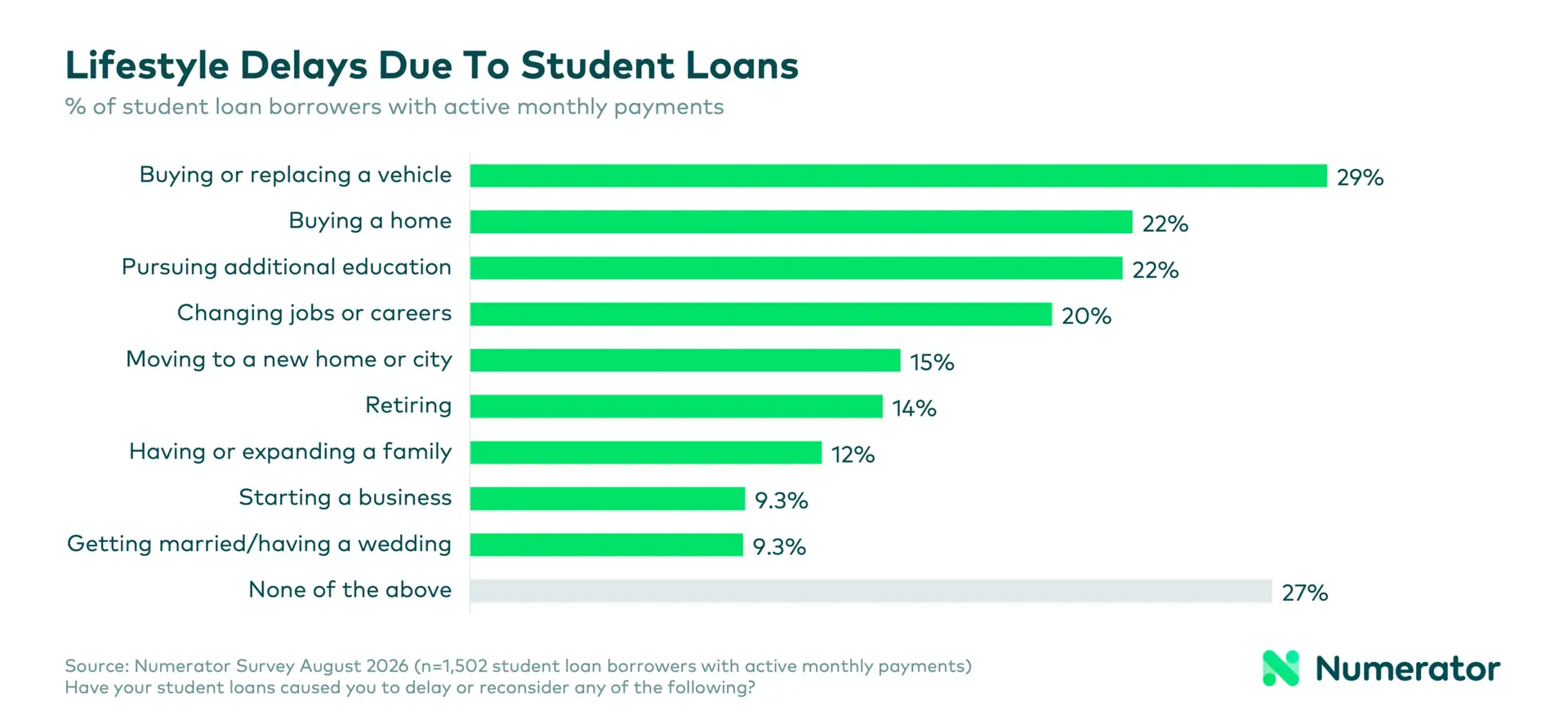
The majority of borrowers (70%) also report delaying or reconsidering a variety of major purchases or life decisions because of their student loans. The most common include buying or replacing a vehicle (29%), buying a home (22%), pursuing additional education (22%), and changing jobs or careers (20%). Smaller shares have delayed retirement (14%), having or expanding a family (12%), or getting married (9.3%).
These delays can extend beyond the decisions themselves. Major life transitions often create purchase occasions across the broader consumer economy—from home furnishings and maintenance to shared household goods and baby products—so postponing them may defer spending across multiple categories. For example, past Numerator analysis has shown that homeowners spend 36% more on home appliances and decor and 72% more on tools & home improvement than renters.
Asked to describe how student loans affect their household’s spending, saving, and financial decisions, borrowers reported a range of experiences, from difficult tradeoffs that leave little room for savings to manageable payments that are more of an annoyance than a burden:
- “I’ve cut back on multiple things and am constantly thinking about how to arrange my expenses in order to make the next payment. I have no savings and also worry about unexpected expenses.”
- “I’m unable to contribute to other household bills because I pay so much toward student loans every month.”
- “It doesn’t have a huge impact since it’s a manageable payment and it isn’t a huge balance. They’re more an annoyance than anything”
Who is most likely to have student loans?
Currently, about one in six adults in the United States carry student loan debt. Roughly two-thirds (67%) of borrowers are between the ages of 25 and 49, and this group accounts for 71% of outstanding student loan debt, according to the latest statistics from the Department of Education. Women are more likely to hold student loan debt than men, and Black adults are more likely to hold student loan debt than adults from other racial and ethnic groups.
Among 5,000 surveyed consumers with higher education, 54% said they had taken out a student loan for their education, and 22% still carried a balance. Respondents ages 21 to 44 were the most concentrated group of borrowers based on demographic targeting alone—65% had taken out student loans and 38% still carried a balance.
How can brands and retailers navigate future student loan policy shifts?
There are several steps brands and retailers can take to prepare for and respond to student loan policy changes. Here are five considerations as the SAVE program ends and in future periods of repayment change:
- Know your relative risk. Use demographic information to build a comprehensive profile of your shoppers. What share has completed some level of higher education? Which age and income brackets do they fall into? These factors can help indicate how much—or how little—your business may be affected when monthly payments change.
- Identify confirmed borrowers. Surveying shoppers about their current student loan status can provide valuable profiling and tracking capabilities. Limit the survey pool to verified buyers of your brand with higher education to make the most of your research budget.
- Prepare to promote. Deal-seeking on everyday goods such as groceries, household essentials, pet products, and baby items is likely to be a key response when student loan payments increase. Brands and retailers can capture spending and build goodwill by tailoring promotional strategies to meet consumer needs during what may be a difficult financial period.
- Meet shoppers online. Digital advertising and promotions give brands flexibility to adjust their strategy as conditions change. A digital strategy also puts brands closer to the younger consumers most likely to have student loans. These consumers favor online shopping and are more influenced by online and social media advertising.
- Track pre- and post-SAVE behaviors. Brands that monitor their performance among student loan borrowers as payments shift will be better positioned to understand changing behavior and adjust their strategies ahead of competitors.
Measure the impact on your brand with Numerator
Although student loan policy remains uncertain, preparation and ongoing monitoring can help businesses minimize potential sales and share losses. Numerator is here to help, with verified shopper surveys, promotional insights, and consumer behavior tracking. Start the conversation with your Numerator representative or reach out to our team to learn more.
