AI CONSUMER INSIGHTS HUB
Understand the AI-engaged consumer.
AI engagement is emerging as a powerful new lens for identifying high-value consumers, spotlighting a shopper segment that brands and retailers can’t afford to overlook. Discover how consumers are using AI today, what’s slowing broader adoption, and how Numerator’s AI Consumer Index reveals where AI-engaged shoppers represent the greatest opportunities for brands and retailers.
AI is becoming a meaningful part of the shopping journey.
Nearly 1 in 3 U.S. households leverage AI platforms.
Select Your View:
Artificial intelligence (AI) has moved beyond early adoption.
Numerator has found that over 30% of U.S. households use AI weekly, contributing nearly 32% of spend across CPG, GM and QSR. Beyond adoption, AI has become a mainstream consumer topic, with nearly one in four consumers ranking it among the issues they’re most concerned about, on par with economic uncertainty and personal health. AI is no longer a niche technology, but has become a part of everyday consumer behavior.
That shift has already changed how consumers shop. Before making a purchase, shoppers are increasingly turning to AI to research products, compare options, validate decisions, and identify savings opportunities. As AI capabilities continue to evolve, consumers are also beginning to use AI for broader planning and decision-making, from meal planning to personalized recommendations. Together, these emerging behaviors suggest AI is becoming a more integrated part of consumers’ everyday decision-making.
For brands and retailers, AI is no longer an emerging trend to monitor. It’s becoming an increasingly important part of how consumers discover and evaluate products.
AI engagement identifies a higher-value consumer.
Brands and retailers must engage with AI-engaged shoppers to capture spend.
AI engagement exists on a spectrum. Numerator research found that 76% of consumers with positive AI sentiment use AI daily or weekly, compared with just 17% of consumers with neutral or negative sentiment. With findings validated at the 99.9% confidence level, positive AI sentiment emerges as a strong indicator of sustained engagement.
In other words, consumers who feel more positively about AI are also more likely to use it regularly.
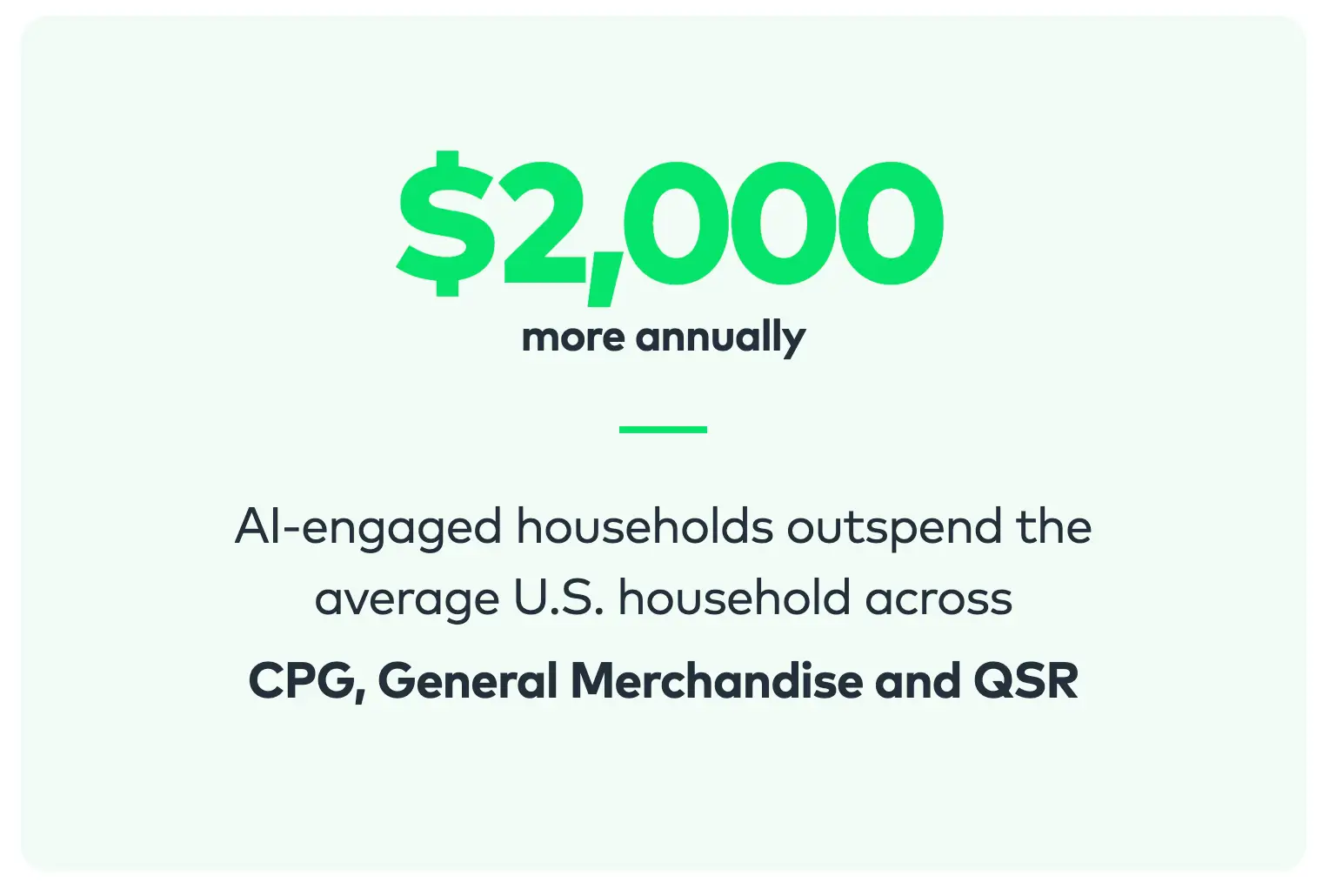
That engagement also translates into measurable business value. Numerator quantified the value of AI-engaged households and learned that AI-engaged households spend approximately $2,000 more annually across CPG, General Merchandise, and QSR, than the average U.S. household, making AI-engaged shoppers a disproportionately valuable consumer cohort.
Although AI adoption varies across generations and income groups, regular AI users spend 5-13% more per household than their demographic peers. This suggests that understanding how consumers engage with AI may reveal high-value opportunities that demographics alone cannot.
AI is influencing shopping, but trust still limits adoption.
Privacy, trust and control will be critical to building consumer confidence in AI-enabled shopping.
Despite growing interest, AI-assisted shopping remains in its early stages. Just 8% of U.S. households report using AI for shopping. However, adoption increases to 13% among current AI users and rises to nearly 18% among regular—daily or weekly—AI users, suggesting that shopping becomes a more common use case as familiarity with AI grows.
Consumers continue to place greater trust in retailer- and brand-owned experiences. While over 40% of consumers are comfortable making purchases through retailer- or brand-owned channels, only 30% are comfortable shopping via AI. This trust advantage positions brands and retailers to introduce AI in ways that build on relationships consumers already value.
Privacy and security remain the most immediate barriers to AI shopping. Nearly half of consumers (48%) are concerned about how their personal data is collected and used, while 41% cite payment security. Trust and accuracy present another hurdle, with roughly one-third of consumers concerned about purchase accuracy, response accuracy, or transparency. Together, these concerns underscore that consumer confidence will be critical to broader AI shopping adoption.
As AI becomes more integrated into the shopping journey, the brands and retailers that succeed will be those that build AI into the relationships and experiences consumers already trust.
As AI adoption continues to grow, brands need to understand which consumers are leading the shift and why they matter.
The Numerator AI Consumer Index.
General merchandise and trend–driven categories are prime for AI-shopping disruption.
AI is poised to disrupt brands and retail, but the pace of change will vary across categories and retailers. To help leaders identify where AI engagement is creating the greatest opportunity, Numerator developed the Numerator AI Consumer Index.
Built from more than 170K panelists segmented by AI usage, sentiment, and AI-assisted shopping behaviors, the AI Consumer Index connects AI-engaged consumers to their verified purchasing behavior. Each Index score is benchmarked against the average U.S. consumer (100), allowing brands to quickly identify where AI-engaged shoppers over- or under-index across categories, retailers, and brands. Scores above 100 indicate above-average spending by AI-engaged shoppers, while scores below 100 indicate below-average spending.
The strongest AI Consumer Index scores center around Electronics, Apparel, and Health & Beauty, pointing to consideration-heavy and trend-driven categories as likely early adopters of AI-enabled shopping. While eCommerce is a top channel, elevated indices across Apparel, specialty retailers, and mission-driven shopping destinations suggest AI’s influence extends beyond digital commerce into a broader range of shopping experiences.
The question for brands and retailers is no longer whether AI will influence shopping, but where its impact will matter most for their business.
How to interpret: A score of 110 means AI-engaged shoppers spend 10% more annually than the average U.S. consumer in that sector.
See Methodology
The AI Consumer Index is calculated by benchmarking household spending among three AI-engaged consumer groups—regular AI users (daily or weekly), consumers with positive AI sentiment, and consumers who use AI while shopping—against the average U.S. shopper. The reported Index score represents the average of these benchmarked measures, where 100 equals the average U.S. shopper.
Get your Numerator AI Consumer Index for your brand and learn about your AI-engaged shoppers.
170K static panelists typed to AI sentiment, behavior and usage to discover historical and in-depth shopping behaviors based on 78 million trips a year across 50K tracked retailers.
Pair the AI Consumer Index with Numerator Verified Voices, enabling you to survey AI-engaged shoppers directly to understand the motivations behind their purchase decisions and uncover opportunities for your business.
Numerator uncovers your consumer to inspire you for growth. Reach out to learn more.
Thank you!
A member of our team will get back to you within 24 hours. In the meantime, explore our content to get a pulse on the latest consumer and shopper insights trends.
Discover our latest thinking on Artificial Intelligence impacting consumer spending.