

The 2026 FIFA World Cup kicks off this June in stadiums across North America, with eleven NFL stadiums in the United States preparing to welcome a different brand of football fans. True to its name, the World Cup has become the largest sporting event in the world, offering unparalleled global visibility and opportunities for brands and advertisers.
US audiences have been slightly slower to adopt soccer as their sport of choice compared to their global counterparts, though these numbers are steadily increasing. Our latest survey dives into US consumer plans for this year’s World Cup, including who’s watching, how they’re tuning in, and the impact it’ll have on their purchase behaviors.
2026 World Cup Viewership Trends
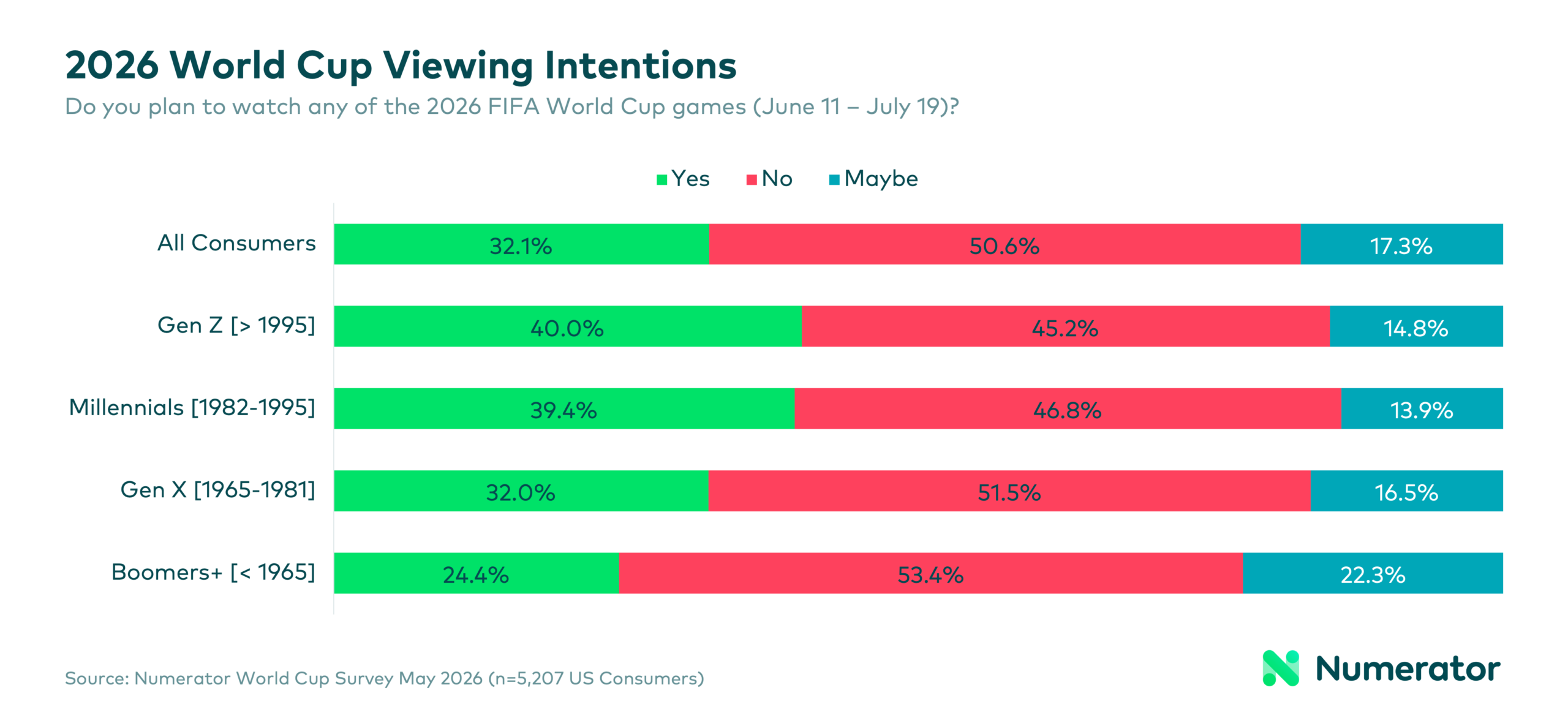
World Cup interest is growing as the event approaches. Nearly a third (32%) of US consumers plan to watch the 2026 FIFA World Cup between June 11 and July 19, up from 26% in a similar survey fielded in January. An additional 17% are considering tuning in, while half (51%) say they won’t watch. Intended viewership for the 2026 World Cup is well below what the US saw for the 2026 Super Bowl (69%) or the 2026 Winter Olympics (58%), but the smaller audience may still offer distinct advantages to advertisers.
While the Super Bowl and the Winter Olympics attract a slightly older audience, the World Cup appeals to a much younger, more diverse group of viewers. Intent to watch the World Cup trends along generation lines, with Gen Z (40%) and Millennials (39%) more likely to watch than Gen X (32%) or Boomers (24%). Hispanic (54%) and Asian (51%) consumers are the most likely groups to watch, and are the only demographic groups with over half planning to tune in.
The ability to connect with this young, multicultural audience will benefit brands looking to break into new markets or to strengthen their relationships with some of the fastest-growing demographic groups in the US.
Streaming and Social Media for the World Cup
With such a young audience, it’s little surprise that digital platforms will see the most engagement during the World Cup. Streaming platforms like Hulu, YouTube TV, and Peacock will be the top choice for World Cup viewers (57%), roughly 10 points ahead of cable or satellite TV (47%). A small portion of viewers (6.3%) expect to purchase new streaming or cable subscriptions for the World Cup.
About a quarter of viewers also plan to tune in or engage with World Cup content on social media platforms like TikTok or Instagram (23%)—higher for Gen Z (37%) and Millennial viewers (32%). This preference for digital media offers advertisers even more opportunity for flexible, ongoing engagement with young consumers throughout the games.
World Cup Watch Parties
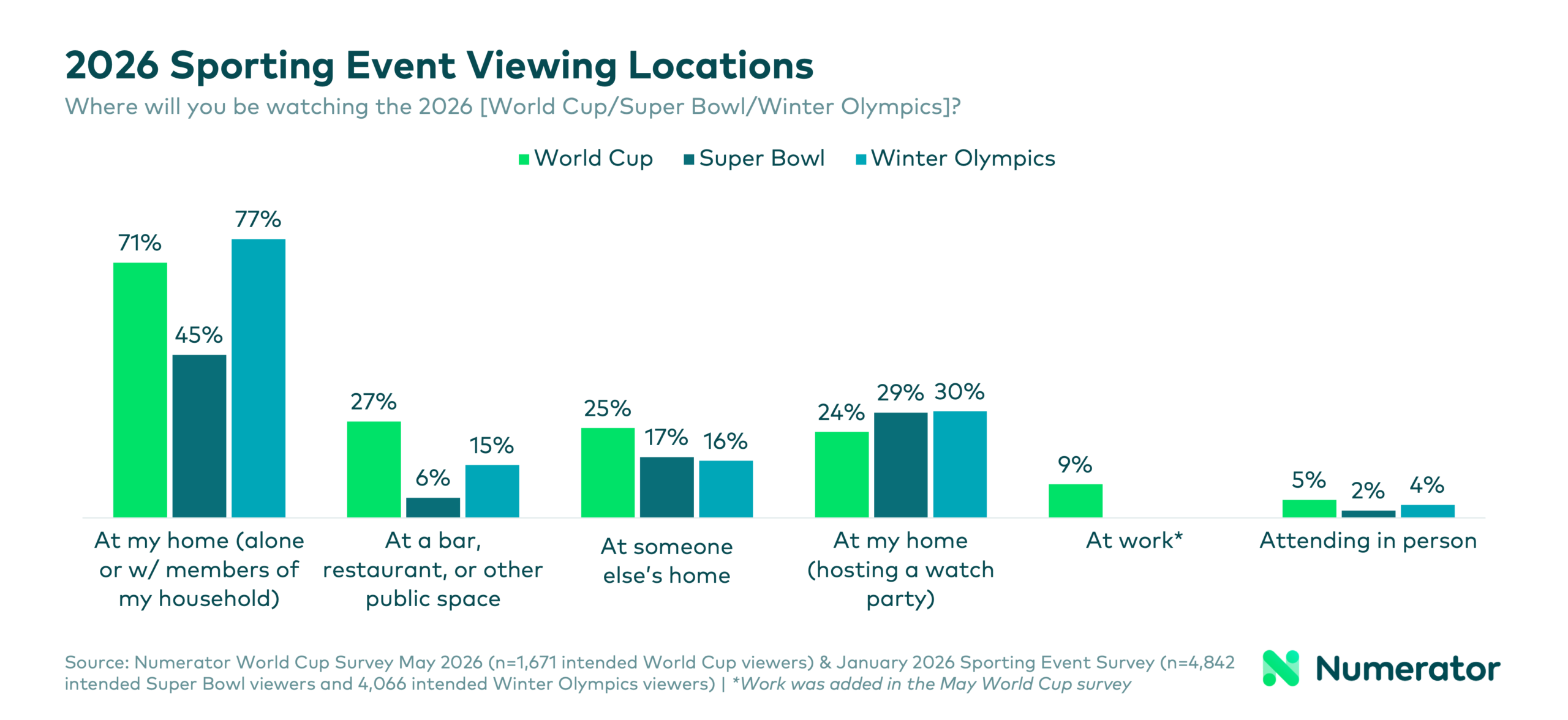
The extended nature of the World Cup offers viewers multiple chances to tune in, with intended viewership building as the July 19 World Cup Final approaches. Watching at home alone or with household members is the most popular plan among World Cup viewers (71%). But with over a month of matches, viewers also plan to shake things up and turn the games into an opportunity for social engagement. Over half (57%) of intended viewers also plan to watch at least some matches in a more social setting:
- 27% will watch from a bar, restaurant, or public space
- 25% will watch at someone else’s home
- 24% will host a watch party at their home
- 9% will tune in from their workplace
- 5% will attend a match in person
Bars and restaurants are likely to benefit from the more public nature of World Cup viewing, with rates 2x higher than the Winter Olympics (15%) and 5x higher than the Super Bowl (5.6%). Even with a smaller viewer base, these spaces are likely to see World Cup traffic at or above that of the Winter Olympics or Super Bowl.
Shopping For The World Cup
Nearly nine-in-ten World Cup viewers (89%) expect to make a purchase related to their game watches. The top items they plan to buy are snacks/chips/dips (51%), alcoholic beverages (38%), prepared foods/appetizers (35%), sweets/desserts (31%), and frozen foods/appetizers (25%). While the top items are similar to those seen for the Super Bowl and Winter Olympics, overall intent to buy something is higher for the World Cup than either of the other major events (Super Bowl 88%, Winter Olympics 71%).
Most intended shoppers (78%) will spend less than $100 on their World Cup-related items, with an expected average spend of roughly $74 per shopper. This is a bit higher than shoppers’ estimates for Super Bowl spending ($68) or Winter Olympics spending ($63). Accounting for expected viewership and purchase intent, World Cup shoppers could drive an estimated $7.5 billion in consumer spending—slightly above a similar estimate for the Winter Olympics ($7.2 billion) but below Super Bowl estimates ($11.5 billion). This estimate excludes spending from those attending a match in person, as their expected expenses are much higher.
Americans Attending World Cup Matches
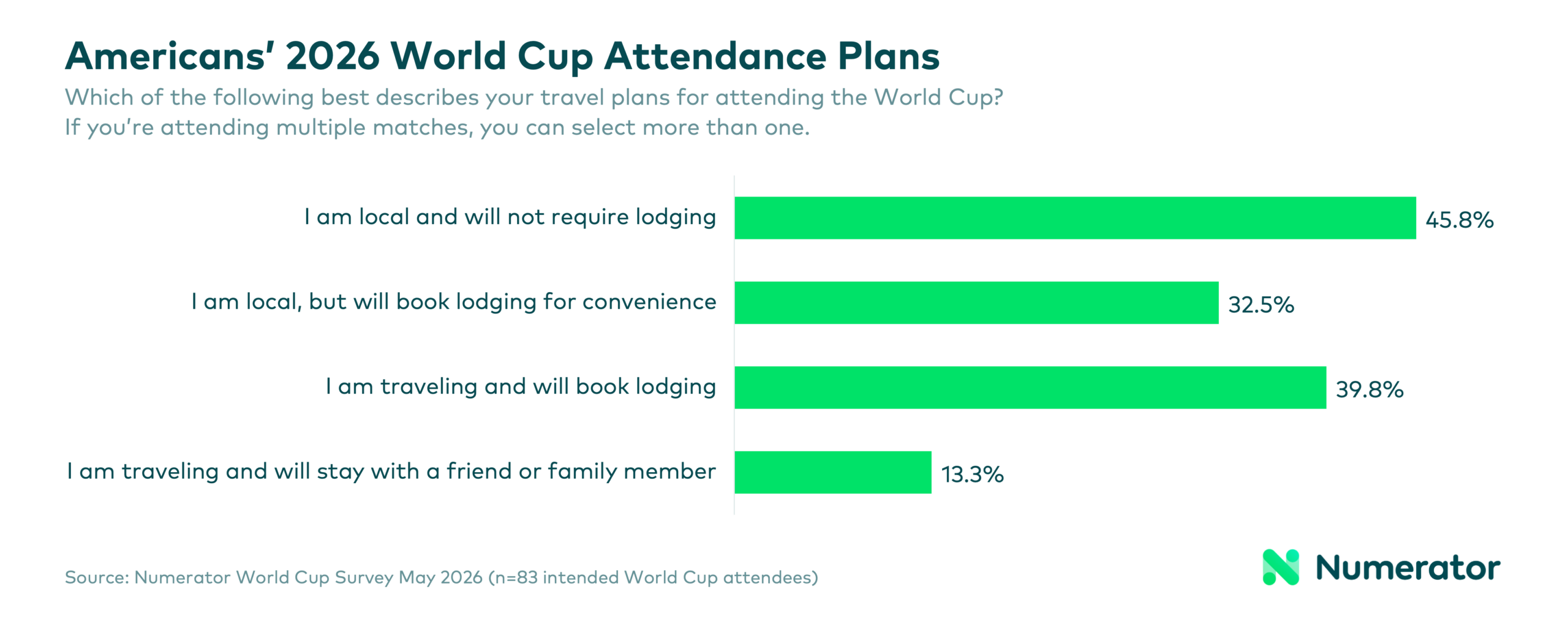
In-person World Cup attendance will be relatively limited among US consumers, and many attendees are looking for ways to save money on their experience. Only 5% of intended viewers—1.6% of US consumers overall—plan to attend a World Cup match in person. Two-thirds (63%) of these individuals plan to attend more than one match. Travel and lodging needs vary significantly among US domestic World Cup attendees:
- 46% are local and won’t require lodging
- 33% are local but will book lodging for convenience
- 40% are traveling and will book lodging
- 13% are traveling but will stay with family or friends
In total, at least half of domestic World Cup attendees (54%) plan to stay at home or with friends and family, supporting recent reports of lower-than-expected hotel demand in host cities.
Taking into account match tickets, travel, lodging, food & beverages, parking & transportation, and any other associated costs for their World Cup experience, American attendees expect to spend an average of $1,667. However, this number is skewed slightly by high spenders; over half (60%) of in-person attendees plan to keep their spend under $1,000, with the largest group (34%) falling in the $100-$499 range.
While this study focuses solely on domestic attendees, the anticipated influx of international travelers—who are likely to stay longer and spend more—will also contribute significantly to the World Cup economic landscape.
Additional World Cup Considerations
Roughly half (52%) of US consumers believe hosting the World Cup will have a positive impact on the 11 US host cities and their residents. A quarter (24%) think the impact will be net-neutral, and fewer than one-in-ten (6.6%) expect negative impacts. People living in these 11 metro areas feel slightly more negative at 8.3%, with the most negative sentiment driven by consumers in the Dallas area (14%), Seattle area (12%), and New York/New Jersey area (10%).
Most consumers expecting positive impacts pointed to potential economic boosts driven by increased tourism to host cities. In contrast, those bracing for negative impacts cited a variety of considerations, including lack of infrastructure, crowd control, traffic and transportation congestion, and increased living costs for locals around matches.
Among the 51% of US consumers who say they won’t watch the World Cup, most referenced a general lack of interest (78%) or lack of time (16%). Only a small portion of non-watchers are abstaining due to concerns about the politics/policies of the host countries (4.9%) or FIFA (4.3%), and only 1.7% of non-viewers are actively boycotting the games.
Looking Ahead
Despite its smaller US audience compared to other major sporting events, the 2026 World Cup still represents one of the most important engagement opportunities of the year—particularly for brands targeting younger, multicultural, digitally engaged consumers.
Commercial impact throughout the World Cup will be driven by a variety of activities, including higher rates of out-of-home viewing, elevated food and beverage spending, extended multi-week engagement, and strong streaming and social media participation. For more information on the 2026 World Cup or other events that impact your business, reach out to your Numerator representative or get in touch with our team.
